
Currently, Android holds a 68.36% global market share, while iOS secures second place with 31.6%. However, in the U.S., iOS leads with 55%, outpacing Android’s 45%.
Additionally, over 90% of iPhone users remain loyal during upgrades, whereas Android users’ loyalty ranges from 70% to 80%.
In this report, we have shared detailed iPhone vs Android market share, global users, impact, and more.
iPhone vs Android Users (2026): Top Picks
- Android holds 68.36% of the global mobile operating system market share currently.
- iOS holds 31.6% of the global mobile operating system market share.
- The United States has the highest market share of iOS with 55%.
- iPhone users spend $101/month on tech, compared to $50 for Android users.
- Over 90% of iPhone users remain loyal to Apple.
- Android loyalty rates range from 70% to 80%, depending on the brand.
iOS Vs Android Market Share (Global)
As of 2026, Android holds a global market share of 68.36%, whereas iOS holds 31.6% market share.
This highlights that Android stays dominant worldwide when it comes to usage.
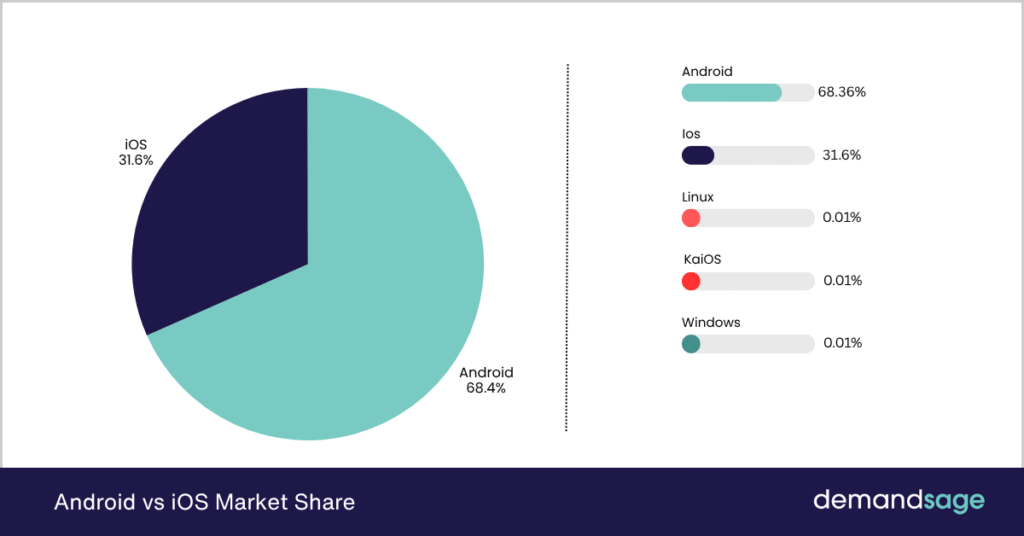
Let us take a look at how the rest of the market compares to this:
| Mobile Operating System | Percentage Market Share |
|---|---|
| Android | 68.36% |
| iOS | 31.6% |
| Linux | 0.05% |
| KaiOS | 0.03% |
| Windows | 0.01% |
Source- StatsCounter
- The USA leads in iOS usage (55%), whereas Android is most widely used in countries like China and India.
- China’s smartphone OS market is led by Android, at 69%, followed by iOS at 14%.
- In India, Android holds a 92% market share, while iOS trails at 8%.

Here are the numbers:
| Country | Android (%) | iOS (%) |
|---|---|---|
| USA | 45% | 55% |
| China | 69% | 14% |
| India | 92% | 8% |
Source- Counter Point Search
India is also on the verge of becoming the largest segment of internet users. Learn how many internet users there are worldwide to better understand.
Android vs. iPhone Market Share in the United States
- iOS and Android both hold 55% and 45% share of the U.S. mobile OS market, respectively.
- iOS consistently leads the U.S. market, with its share fluctuating between 50% and 65% over the past 10 quarters.
- The largest gap was in Q4 2024, when iOS led Android by 30%. In the United States, iOS phones accounted for 65% of the market, while Android phones held only 35%.
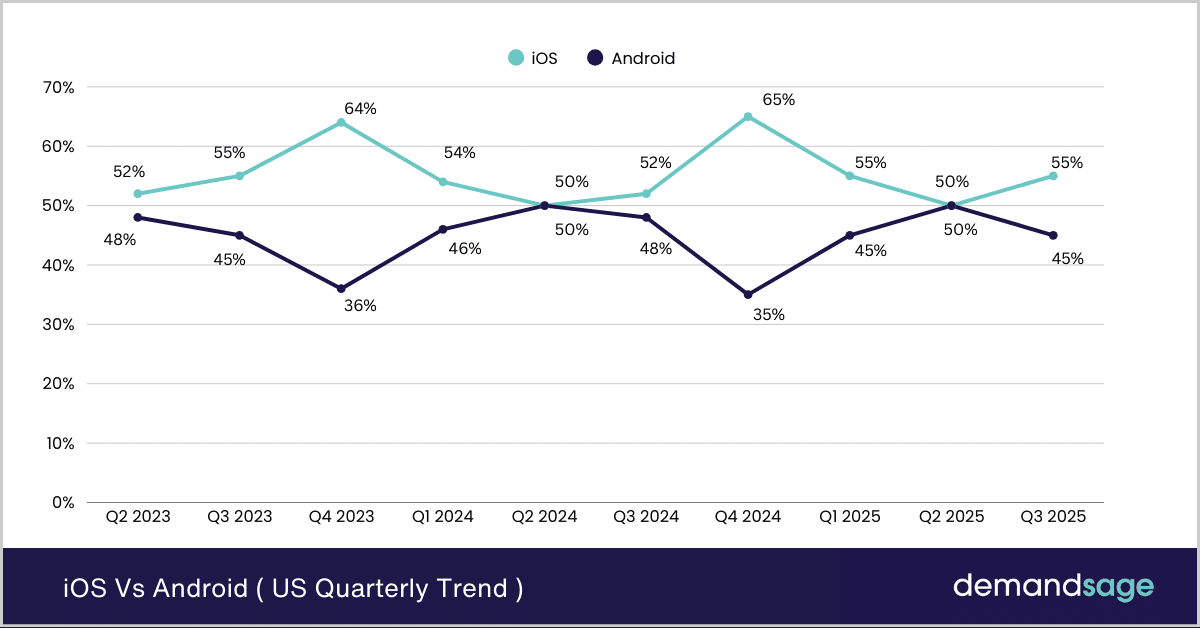
Here’s a full quarter-by-quarter breakdown from 2023 to 2025 of the mobile operating market share in the USA for Android and iOS :
| Quarter | iOS | Android |
|---|---|---|
| Q2 2023 | 52% | 48% |
| Q3 2023 | 55% | 45% |
| Q4 2023 | 64% | 36% |
| Q1 2024 | 54% | 46% |
| Q2 2024 | 50% | 50% |
| Q3 2024 | 52% | 48% |
| Q4 2024 | 65% | 35% |
| Q1 2025 | 55% | 45% |
| Q2 2025 | 50% | 50% |
| Q3 2025 | 55% | 45% |
Source: Counter Point Search, Stats Counter
Apple Vs Android Market Share: Users
- As per the latest data, iPhones account for 62% of smartphone shipments in the U.S., while Android holds around 38%.
- iPhone users spend 5 hours/day on their phones, whereas Android users spend 3.7 hours.
- iPhone users spend an average of $101 per month on technology, nearly twice the amount spent by Android users.
- Additionally, iPhone users take approximately 12 selfies daily, compared with 7 per day among Android users.
- Regarding fashion expenses, iPhone users spend about $117 per month on clothing, whereas Android users spend about $62.
- Furthermore, iPhone users spend an average of $83 on beauty products, compared to $40 for Android users.
Source- PRN News, Counter Point Search
Apple Vs Android User Demographics
- 60% of male smartphone users globally prefer Android, compared to 54% of female users.
- 31% of women globally own an iPhone, higher than 28% of men.
- In the U.S., 68% of 18–to 29-year-olds used iPhones, making iOS the dominant smartphone operating system in this age group.
- The 25–34 age group makes up the largest segment of iPhone users globally.

Here is a quick breakdown:
| Age Group | Percentage of iPhone Users |
|---|---|
| 25-34 | 27% |
| 35-44 | 23% |
| 18-24 | 22% |
- iPhone users are also more educated; they are 27% more likely to have a graduate or PhD-level education, and 55% more likely to hold a four-year degree.
- In the U.S., iPhone users are more likely to earn over $75,000 per year and 48% more likely to earn over $125,000 than Android users.
Source- Market Scoop, Statista
Find More Android usage statistics in our in-depth research that helps you understand why this market is so huge.
Are There More Android or iPhone Users In The US?
- In terms of active users, there are approximately 124.7 million iPhone users in the U.S. (2024), growing by 7.22% year-over-year.
- In early 2025, there were approximately 100 million Android users in the United States, accounting for approximately 40.4% of all smartphone users.
iPhone vs Android Users Behavior
- 78% of mobile gamers are Android users, driven by the wide availability of budget-friendly Android phones.
- 85% of Android users express privacy configuration as a top concern, especially regarding app permissions and data-sharing settings.
- iPhone users have higher average incomes: $85,000/year vs. $61,000/year for Android users.
- 27% of iPhone users hold graduate or PhD degrees vs. 8% of Android users.
Source: Statista, Market Scoop, Com Score
Android Users vs iPhone Users App Ecosystem
- iOS accounted for over 65% of global app store revenue, despite Android users comprising more than 70% of smartphone usage by users worldwide.
- In gaming, 78% of global mobile gamers use Android, yet iOS still drives more revenue per user.
- iPhone users generally spend more on applications; for instance, an iPhone user spends an average of $1.64 per app, compared to $0.43 for Android users.
Source: Market Scoop, Statista, Sensor Tower
Sage Reads: Apple Statistics
iPhone Users vs Android Users: Loyalty and Switching Habits
- Based on iPhone users statistics, over 90% choose another iPhone when upgrading, while Android user loyalty ranges between 70% and 80%, depending on the region and brand.
- Additionally, 29% of iPhone owners kept their previous devices for three years or longer, compared to only 21% of Android users.
Source: CIRP
