
Around 82% of internet traffic will be video by 2026, with users spending an average of 100 minutes per day watching online videos, proving it’s no longer just an add-on but the backbone of digital marketing.
Platforms like TikTok and Instagram now drive 70% higher engagement with short-form clips, while YouTube long-form videos contribute to 90% of online learning consumption.
Hence, it makes sense why 91% of marketers actively use video marketing, and 93% see it as a crucial tool in their strategy. In 2026, video marketing is going to be more important than ever.
In this article, we break down the latest video marketing, video SEO statistics, traffic shifts, and consumption trends, helping you see exactly why video dominates digital strategy.
Video Marketing Statistics 2026: At A Glance
- Around 93% of marketers are currently integrating video into their marketing strategies.
- Most marketers are seeing results, as 82% report positive ROI from video marketing.
- Two out of three consumers (66%) find short-form videos the most engaging type of content.
- Social media marketers use video content the most (69%) for marketing.
- Over 85% of people admit that watching a video influenced their purchase decision.
- Users typically spend 88% more time on websites that feature video content.
- Close to 84% of consumers want to see more video content from brands.
- Video makes up roughly 82.5% of all global internet traffic.
Online Video Marketing Usage Statistics 2026
- Currently, the percentage of marketers using video marketing has increased slightly to 91%.
- Looking back, 2023 and 2024 had the highest participation, with 91% of marketers actively using video marketing. This showed strong and steady growth in the industry.
- This peak didn’t happen overnight. Between 2020 and 2023, the percentage gradually increased from 85% to 91%, as more marketers adopted video marketing.
- However, one of the biggest jumps happened much earlier.
- From 2017 to 2018, the percentage shot up from 63% to 81%—an 18% rise that likely signaled a significant shift in marketing trends.
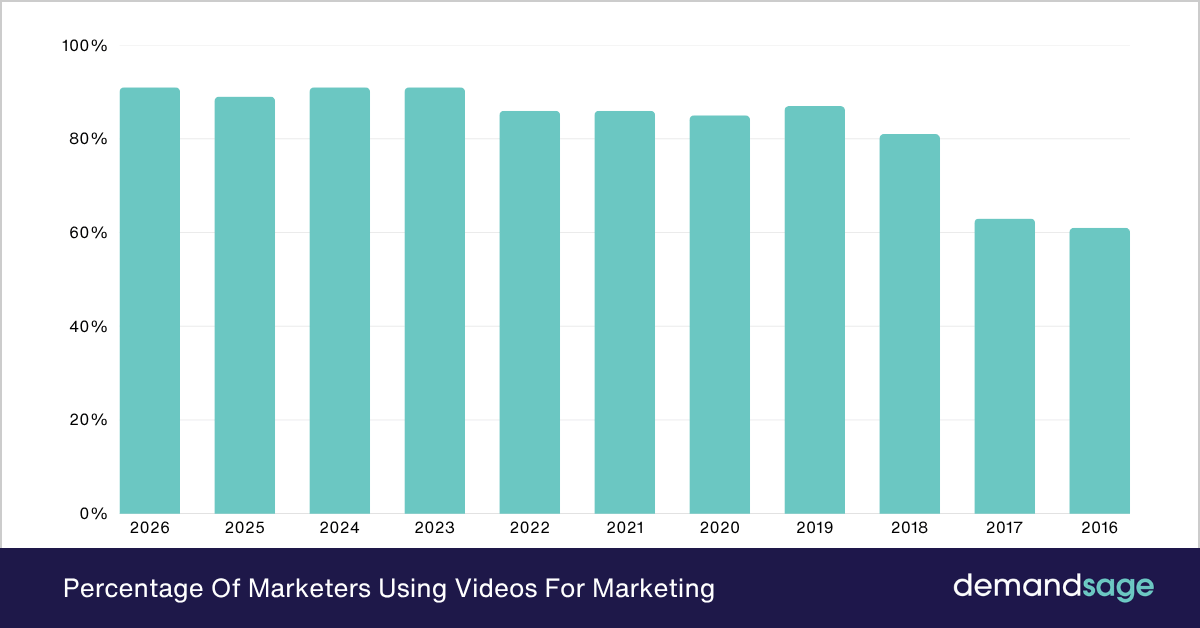
The following table displays the percentage of marketers who use videos for marketing purposes over the years:
| Year | Percentage of Marketers Using Video marketing |
|---|---|
| 2026 | 91% |
| 2025 | 89% |
| 2024 | 91% |
| 2023 | 91% |
| 2022 | 86% |
| 2021 | 86% |
| 2020 | 85% |
| 2019 | 87% |
| 2018 | 81% |
| 2017 | 63% |
| 2016 | 61% |
Source: Wyzowl
- Right now, the percentage of marketers who see video as a crucial marketing tool has increased to 93%, up from 88% in 2024.
- However, 2024 saw a notable decline, dropping to 88% from 96% in 2023. This was a rare dip after years of steady growth, suggesting that certain challenges or shifting trends may have impacted video marketing adoption.
- Looking at the bigger picture, video marketing has come a long way.
- One of the most significant jumps happened between 2015 and 2018, when the percentage rose from 78% to 85%, a 7% increase in just three years.
This rapid growth was likely fueled by the rise of social media videos and short-form content.
- Overall, video marketing has evolved from an emerging trend to an essential part of marketing strategies.
The percentage of marketers recognizing its importance has grown steadily from 78% in 2015 to 93% as per the latest data, proving that video is now a dominant force in the industry.
Here is a table displaying the percentage of marketers who consider videos as a crucial marketing tool.
| Year | Share Of Marketers |
|---|---|
| 2026 | 93% |
| 2025 | 95% |
| 2024 | 88% |
| 2023 | 96% |
| 2022 | 92% |
| 2021 | 93% |
| 2020 | 92% |
| 2019 | 91% |
| 2018 | 85% |
| 2017 | 82% |
| 2016 | 88% |
| 2015 | 78% |
Source: Wyzowl
- 92% of video marketers plan to maintain or increase their investment in video.
- Conversely, 8% of the marketers stated that they plan to reduce their spending on videos.
Here is a breakdown of the share of marketers that are planning to invest more, the same, or less in videos for marketing:
| Investment In Videos | Percentage Of Marketers |
|---|---|
| Invest same or more | 92% |
| Invest less | 8% |
Source: Wyzowl
- The majority of the video marketers (69%) have created social media videos.
- Meanwhile, explainer videos were the second most created type of video, with 68% of the marketers investing in them.
- Testimonial videos, presentation videos, and video ads are the other videos that make it to the top 5 most created video types.
Here is a table displaying the most created video types by marketers:
| Video Type | Percentage of Marketers |
|---|---|
| Social media videos | 69% |
| Explainer videos | 68% |
| Testimonial videos | 57% |
| Presentation videos | 48% |
| Video ads | 48% |
| Teaser videos | 45% |
| Product demo videos | 39% |
| Sales videos | 37% |
| Videographics | 27% |
| Customer service videos | 24% |
| Staff training videos | 23% |
| Customer onboarding videos | 23% |
| App demo videos | 17% |
| Employee onboarding videos | 16% |
Source: Wyzowl
- 30% of marketers who currently don’t use short-form videos plan to start investing in them.
- Short-form videos have the highest ROI and engagement compared to other video formats.
- As a result, 3 out of 10 marketers who have yet to enter the short-form video market are eager to begin this year. At the same time, a quarter of marketers are planning to increase their investment in short-form videos this year.
With video driving a massive increase in dwell time, optimizing those high-traffic pages is critical. Software brands typically use a SaaS content marketing agency to build the written SEO framework that ranks the page, then embed a video to capture that attention.
Source: Hubspot
Video Marketing ROI Statistics
- 82% of the marketers say that video marketing gave them a positive ROI.
- Comparatively, 93% of the marketers in 2025 stated the same.
- These numbers display a 11% decrease in the share of marketers who have received good returns on their video marketing investments.
- Back in 2016, just 76% of marketers who invested in video marketing received good returns. The data clearly shows that a significant portion of marketers who invest in video marketing are seeing strong returns.
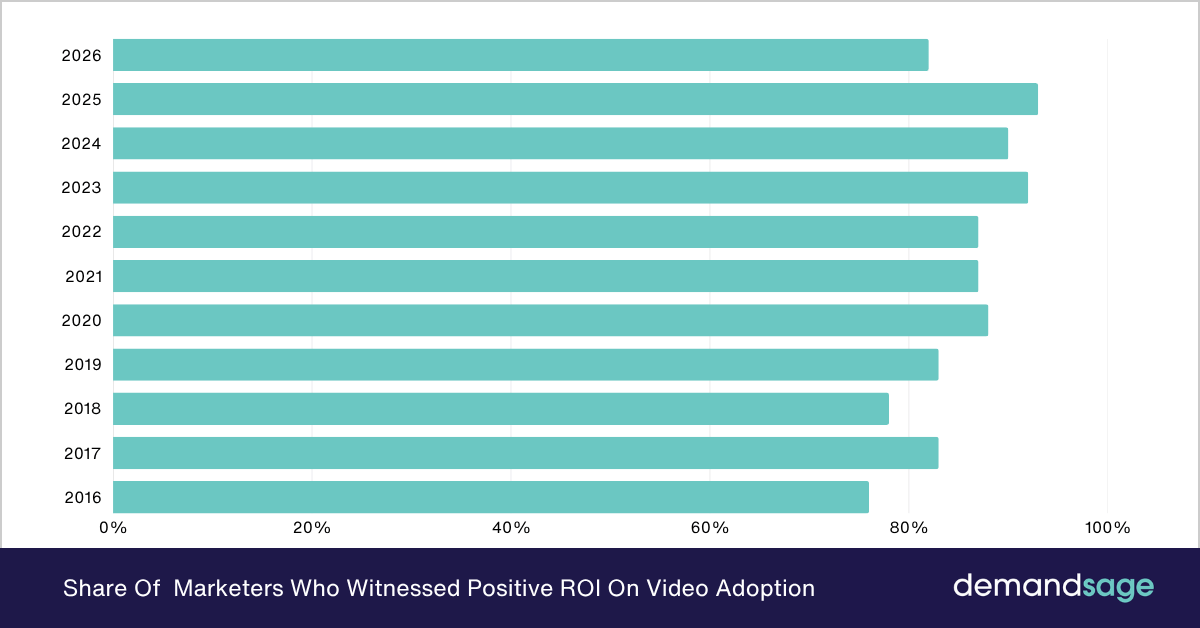
Here is a table displaying the share of video marketers who received a good ROI after adopting videos in their marketing strategy:
| Year | Percentage of Marketers |
|---|---|
| 2026 | 82% |
| 2025 | 93% |
| 2024 | 90% |
| 2023 | 92% |
| 2022 | 87% |
| 2021 | 87% |
| 2020 | 88% |
| 2019 | 83% |
| 2018 | 78% |
| 2017 | 83% |
| 2016 | 76% |
Source: Wyzowl
- 83% of marketers reported that videos have directly boosted their sales.
- This figure remains strong, though it reflects a slight dip from 87% in 2023 and continues a long-term upward trend from just 64% in 2016.
- At the same time, 85% of marketers mentioned that videos have been effective in generating leads, while 82% noted that videos helped keep visitors on their websites for longer.
- Additionally, 93% of marketers said that videos have played a key role in boosting brand awareness.
Source: Wyzowl.
Video Engagement Statistics
- Videos shorter than 1 minute achieve an engagement rate of 50%.
- Shorter videos have a higher engagement rate. Conversely, longer videos have lower engagement rates.
- Videos that last longer than 60 minutes have an engagement rate of just 17%.
The following table displays the video engagement rates by length of the video:
| Length Of The Video | Video Engagement Rate |
|---|---|
| Less than 1 minute | 50% |
| 1 to 3 minutes | 48% |
| 3 to 5 minutes | 47% |
| 5 to 30 minutes | 39% |
| 30 to 60 minutes | 26% |
| More than 60 minutes | 17% |
Source: Wistia
- Video livestreams reached 26.8% of the audience.
- They have the third-highest reach among all the video types. The highest reach is recorded for music videos, with a weekly reach of 50.2%.
- Organic engagement increases by 41% when websites use video content in their primary Video SEO.
- At the same time, comedy, memes, and viral videos have the second-highest reach of 35%, while educational videos reach 26% of the audience.
Marketers can use our live streaming statistics to understand videos, tutorials, how-to videos, Product review videos, and Influencer videos and vlogs to increase their reach and brand awareness.
Here is a table displaying the popular video content types worldwide by weekly usage reach:
| Type of Video Content | Reach of Video Content |
|---|---|
| Music video | 50.5% |
| Comedy, meme, or viral video | 35% |
| Video live stream | 26.8% |
| Sports clips or highlights video | 26.4% |
| Product review video | 26% |
| Tutorial or how-to video | 25.2% |
| Educational video | 24.9% |
| Sports match or commentary | 24.6% |
| Influencer videos and vlogs | 23.2% |
| Gaming video | 22.8% |
Source: Statista.
Video Consumption Trends Statistics
- 84% of people say they want to see more online videos from brands.
- That’s a decrease of 2 percentage points compared to 91% of the consumers who wanted to see more videos from brands in 2023.
- Comparatively, just 85% of the consumers in 2018 wanted to see more videos from brands.
- This demand aligns with the fact that 63% of people prefer watching a short video over accessing instructional or informational content through text-based articles, infographics, or sales calls.
- 96% of people have watched an explainer video to learn more about a product or service. Meanwhile, 80% of people have bought or downloaded an app after watching an app demo video.
- 89% of consumers say that video quality impacts their trust in a brand. This highlights why businesses should invest in producing polished, professional-looking video content rather than just increasing volume.
Source: TechSmith, Wyzowl.
- Video accounts for 82.5% of global internet traffic,
- This is an increase of 88% in internet video traffic compared to that recorded in 2017. In that year, video accounted for 72.3% of the internet traffic.
- This increase is because 80% of people prefer to watch videos over reading texts.

Source: Nealschaffer.
- 66% of consumers report short-form videos as the most engaging content.
- Short-form videos have an average watch rate of over 81%. Besides, 59% of short-form videos are watched for 41% to 80% of their length.

- Besides, 73% of consumers prefer short-form videos to search for products or services.
- Meanwhile, 57% of Gen Z prefer short videos to learn about products and services.
- Due to these facts, 85% of marketers believe short-form videos are the most effective format for video content.
Source: Social Sprout.
- 85% of people say watching a video has convinced them to buy a product or service.
- These figures show that videos strongly influence consumers’ purchase decisions and keep users engaged.
- Further, 83% of marketers reported that they witnessed an increase in their sales after investing in video marketing.
Hence, businesses must invest in video content to create an impact on users and increase their profits.
Source: Wyzowl, Forbes.
- The average user spends 88% more time on websites that have videos.
- Videos help to increase traffic to your website. They keep consumers engaged, which leads to longer visits.
- Plus, videos help users retain 95% of the information explained, compared to 10% when it is read.
- Further, the increase in click-through rate with video is as high as 96%, and videos are shared 1200% more times than links and text combined.
This is because people are more likely to believe the information presented if it is explained through video. Learn about these web traffic stats in our detailed report.
Source: Forbes
- 85% of internet users in the United States watch online video content.
- Compared to other countries, 95% of internet users in Saudi Arabia and Turkey prefer to watch online content. Besides, Saudi Arabia ranks first in daily online video usage.
- Adults in the 25- to 30-year-old age group watch the most online videos. Meanwhile, men spend 40% more time watching videos on the internet than women.

The following table displays the penetration rate of online video content in different countries worldwide.
| Country | Share Of Internet Users Watching Online Video Content |
|---|---|
| Saudi Arabia | 95% |
| Turkey | 95% |
| China | 92% |
| New Zealand | 91% |
| Mexico | 88% |
| Australia | 88% |
| Philippines | 87% |
| Spain | 86% |
| India | 85% |
| Brazil | 85% |
| United States | 85% |
Source: Statista, Scope Weekly.
- YouTube is the most widely used video marketing platform, with 82% of businesses uploading their video content to it.
- With 2.7 billion monthly active users, our YouTube statistics show that it is one of the most preferred online social media platforms for video content.
- Users spend around 49 minutes daily on YouTube.
Source: BroadBandSearch
Hence, marketers consider it to be one of the best platforms to advertise their video content.
- LinkedIn and Instagram follow YouTube. Notably, LinkedIn has climbed to the second most widely used platform for video marketing, with 8 in 10 B2B teams naming it their primary video-sharing channel according to Wistia’s 2026 State of Video Report.
The following table displays the share of marketers who prefer different social media platforms for video marketing.
| Platform | Marketers That Prefer The Platform For Video Marketing |
|---|---|
| YouTube | 82% |
| 70% | |
| 69% | |
| 66% | |
| Webinars | 56% |
| TikTok | 40% |
| X (Twitter) | 29% |
Source: Wyzowl.
Check social media statistics before you start your content creation journey.
- 75% of consumers watch video content on mobile devices.
- These high viewing rates from smartphone usage stats are because they can be watched on the go and from anywhere.
Source: Wyzowl, Hubspot.
- A person watches an average of 17 hours of online video per week.
- This number has decreased from the average of 19 hours recorded in 2022.
- Globally, the average person consumes 84 minutes of video content every day.
- Meanwhile, People in China watch videos for approximately 103 minutes daily.

Source: Wyzowl, The Social Sheperd.
- Nearly 50% of internet users look for videos related to a product or service before visiting a store.
This shows that internet users consider video product reviews crucial when looking forward to purchasing a product.

Through videos, consumers can learn things they wouldn’t know about a product or service if they’d read texts alone.
- Four times as many consumers would rather watch a video about a product, rather than read about it.
- Further, Shoppers who view demo videos are 1.81 times more likely to purchase than non-viewers.
- Besides, 65% of executives have navigated to a vendor’s site, and 39% have called a vendor after watching a marketing video.
Source: Forbes, Emarketer, Biteable, Think with Google.
Video Marketing Facts
- Brands are increasingly investing in short-form video (30%), long-form video (29%), and live streaming (30%), while traditional formats continue to decline in usage.
- Visual storytelling will have officially overtaken text-heavy formats as a core content strategy for marketers.
- YouTube Shorts now generates over 200 billion daily views, up from 70 billion in early 2024. This nearly threefold increase in under two years shows how quickly short-form video consumption is accelerating on established platforms.
Here is the media format used by both B2B and B2C marketers:
| Media Format | Share of B2B Marketers | Share of B2C Marketers |
|---|---|---|
| Short-form video | 30% | 30% |
| Images | 29% | 30% |
| Interviews | 24% | 21% |
| Blog posts | 23% | 20% |
| Long-form video | 19% | 18% |
| User-generated content | 18% | 21% |
| Live streaming video | 17% | 22% |
Source: Hubspot
Video Performance Stats
- Videos over 60 minutes have an average pay rate of 58%.
- Longer videos usually have a higher play rate compared to shorter videos. Videos less than 1 minute have an average play rate of 23%, while videos of 1 to 3 minutes have an average play rate of just 12%.
The following table displays the average play rate benchmark by video length.
| Length Of The Video | Average Play Rate |
|---|---|
| Less than 1 minute | 23% |
| 1 to 3 minutes | 12% |
| 3 to 5 minutes | 17% |
| 5 to 30 minutes | 35% |
| 30 to 60 minutes | 50% |
| More than 60 minutes | 58% |
Source: Wistia
- Videos over 60 minutes have an average conversion rate of 13%.
Similar to play rate, video conversion rates are higher for longer videos than shorter videos.
- Videos that last less than a minute have an average conversion rate of just 1%, and videos between 1 and 3 minutes have a conversion rate of 4%.
- Conversely, videos between 5 and 30 minutes have a conversion rate of 11%, and videos that last over 60 minutes have the highest conversion rate.
The following table displays the average conversion rates by video length:
| Length Of The Video | Average Conversion Rate |
|---|---|
| Less than 1 minute | 1% |
| 1 to 3 minutes | 4% |
| 3 to 5 minutes | 2% |
| 5 to 30 minutes | 11% |
| 30 to 60 minutes | 8% |
| More than 60 minutes | 13% |
Source: Wistia
- Companies that use video grow their revenue 49% faster YoY.
- They also have 27% higher click-through rates and 34% higher web conversions.
This is an effect of higher traffic and engagement rates. They lead to an increase in click-through and conversion rates, eventually increasing the revenue of the business or the brand.
Source: Jilt.
- Video marketers get 66% more qualified leads per year.
- Further, 84% of marketing professionals claim video helped them with lead generation.
- Videos help nurture leads by attracting 300% more web traffic. A website with a video is 53 times more likely to appear on the front page.
These factors contribute to attracting qualified leads, which later result in conversion.
Source: Marketing Sherpa, Insivia, Levitate Media.
Video Creation Statistics
- 38% of marketers create their content in-house.
- This is down from 60% of marketers who created content in-house in 2023.
- Meanwhile, 24% of video marketers prefer to get their content created from external vendors, and 38% of marketers rely on both in-house and external vendors for content creation.
Source: Wyzowl
- Three-fourths of video marketers make use of AI tools to create or edit marketing videos.
- AI has been embraced across nearly every industry worldwide, and video marketing is no exception. In fact, 75% of video marketers report using AI tools throughout the video production process.
- Video marketers have started adopting AI tools for video creation and editing tasks to speed up content production.
Source: Wyzowl
- According to 85% of marketers, the adoption of generative AI will transform the way they create content.
- 59% of marketers already use generative AI to auto-generate captions and transcription.
- Meanwhile, 49.8% of marketers use generative AI to generate scripts, outlines, and ideas.
The following table displays the ways marketers use generative AI for video creation:
| Usage of Generative AI | Percentage of Marketers |
|---|---|
| Auto-generating captions or transcripts | 59% |
| Generating a script, outlines, or ideas | 49.8% |
| Generating visuals, music, or fixing overdubs | 25.1% |
| Finding key clips to edit | 29.3% |
| Helping create social promotion copy | 25.5% |
| Don’t use or plan to use AI tools for videos | 13.5% |
Source: Hubspot, Wistia.
- Nearly half of businesses, about 45%, expressed a desire to produce more product videos.
- These companies believe that product videos are a great way to highlight their products and expertise. Additionally, 38% of businesses are eager to create educational and instructional content.
- Meanwhile, 35% of businesses want to create social media videos and 32% are looking forward to hosting webinars and live events.
Here is a table displaying the type of video content that companies are looking forward to creating:
| Type of Video | Percentage of Companies |
|---|---|
| Product videos | 45% |
| Educational and instructional content | 38% |
| Social media videos | 35% |
| Webinars and live events | 32% |
| Customer testimonials | 26% |
| Promotional videos | 27% |
| Sales videos | 18% |
| Original series | 17% |
| Company culture videos | 9% |
Source: Wistia, Hubspot.
Conclusion: Over 9 In 10 Marketers Today Use Video For Marketing
With 82% of marketers reporting positive ROI, and 88% crediting video with boosting sales and leads, businesses cannot afford to overlook its impact.
If you are a marketer or a brand, please remember that on average, a consumer spends 17 hours per week watching online video. Monetize this attention for yourself.
As text-heavy formats lose relevance, video’s dominance will only deepen, making it the most effective medium to engage audiences and drive measurable results from 2026 and ahead.
